Reading Your Cat's Body Language: What the Science Actually Says
Here's something that might sting a little: research shows that humans misread cats' signals indicating stress, discomfort, or threat about one-third of the time. That's a lot of missed cues.
The good news? Scientists have been studying cat communication more intensively in recent years, and we now have actual data on what those tail flicks, ear positions, and slow blinks really mean. No more guesswork.
The Short Version
Cats communicate primarily through body language, not vocalisations (those meows are mostly reserved for humans). The key signals to watch are ears, tail, eyes, and body posture – and they need to be read together, not in isolation. A slow blink means your cat trusts you. A tail held high signals friendly intentions. Flattened ears mean fear or aggression. And dilated pupils? Context is everything.
Why Cat Communication Is Different
Unlike dogs, who evolved as pack animals with complex social hierarchies, cats are primarily solitary hunters. They developed subtle communication methods out of necessity – loud signals would alert prey or rivals.
Here's an interesting finding from research published in ScienceDirect: cats have specifically developed vocal communication for interacting with humans. When communicating with other cats, they favour chemical (scent) and visual signals over vocalisations. Those meows and chirps? They're largely for your benefit.
The research also found that information from cats is best understood by humans when it's "bimodal" – combining visual and vocal signals. Pure vocal signals alone are the hardest for us to interpret correctly.
The Slow Blink: Science Confirms What Cat Lovers Suspected
You've probably heard that slow blinking at your cat is a way to show affection. But until 2020, no one had actually tested this scientifically.
Researchers at the University of Sussex, led by Professor Karen McComb and Dr Tasmin Humphrey, ran two experiments to find out if the "cat smile" is real. Their findings were published in Nature's Scientific Reports.
What They Found
In the first experiment, 21 cats from 14 households were observed while their owners slow-blinked at them from about a metre away. The result? Cats were significantly more likely to slow blink back at their owners after receiving a slow blink, compared to when there was no interaction.
The second experiment was even more interesting. Researchers – strangers to the cats – either slow-blinked or maintained a neutral expression. The cats approached the slow-blinking strangers significantly more readily than those who just stared.
How to Do It
Professor McComb's advice: "Try narrowing your eyes at them as you would in a relaxed smile, followed by closing your eyes for a couple of seconds. You'll find they respond in the same way themselves and you can start a sort of conversation."
This works with cats you've never met too. If you're visiting a cattery and want to make a good impression on a potential guest, slow blinking is your best opening move.
Reading the Tail: What Research Actually Shows
The tail is one of the most expressive parts of a cat's body, but it's often misunderstood. Here's what the science says.
The "Tail-Up" Signal
Research from Southampton in the 1990s first documented that the tail-up position precedes friendly interactions. Cats who approached each other with tails raised were more likely to rub heads and sit together afterward.
But here's something most articles miss: tail-up appears to be a signal of hierarchy recognition. Studies found that low-ranking cats display the tail-up posture more frequently, and high-ranking individuals receive it more often. It's not just "I'm happy" – it's closer to "I acknowledge you and want to interact peacefully."
This is actually a neotenic behaviour – something kittens do when greeting their mother that continues into adulthood. It retains those positive emotional associations.
What Different Tail Positions Mean
Straight up (sometimes with a slight curve at the tip): This is your cat's way of saying hello. They're confident, comfortable, and open to interaction. According to PMC research, the tail-up display is particularly important when cats approach humans.
Question mark shape: Playful mood. Your cat is asking "Want to play?" This is a good time to grab that feather toy.
Low or tucked under: Fear, anxiety, or submission. A cat tucking their tail is trying to make themselves smaller. Something in their environment is causing stress.
Puffed up (the Halloween cat): Startled or frightened by a sudden threat. The piloerection (hair standing on end) makes them appear larger – a defensive response.
Thrashing or thumping: Irritation or agitation. If you're petting your cat and the tail starts thrashing, stop immediately. This is a clear signal to back off.
Slow swish: Focused attention. Your cat is locked onto something – possibly about to pounce on a toy (or your ankles).
Wrapped around another cat or person: Affection and friendship. The feline equivalent of putting your arm around someone.
The Eyes: Windows to Emotional State
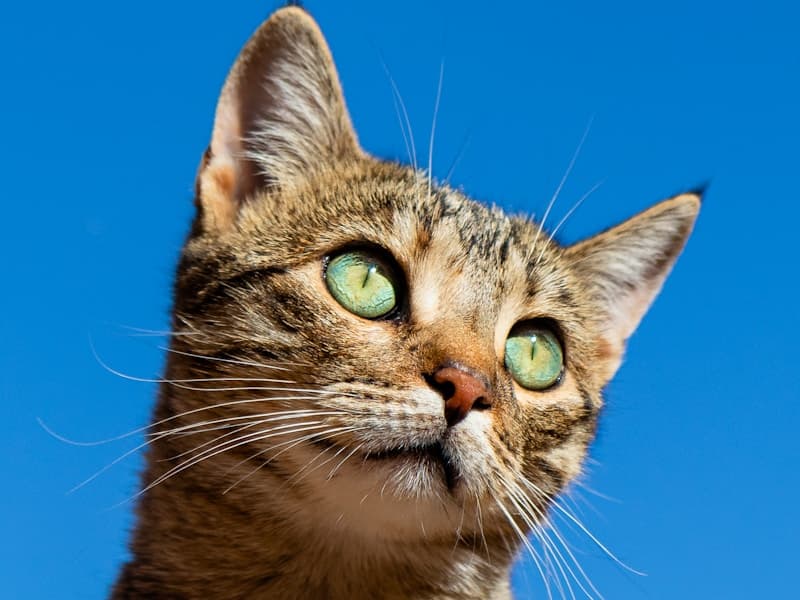
Cat pupils can dilate up to 135 times their narrowed size – that's over 100 times more than human pupils. And while light affects pupil size, under stable conditions, those changes are driven by emotion.
Dilated Pupils (Large and Round)
Wide pupils signal emotional arousal. The tricky part is figuring out which emotion.
Playful context: Large pupils plus ears forward plus tail up means your cat is excited and engaged.
Fearful context: Large pupils plus flattened ears plus crouched body means terror. The autonomic nervous system has triggered fight-or-flight mode.
Pain: Dilated pupils can indicate physical discomfort, even if your cat isn't showing other obvious signs.
The key insight from Fear Free veterinary practices is that pupil changes are involuntary. Cats can't fake them. This makes eyes one of the most reliable indicators of emotional state.
Constricted Pupils (Narrow Slits)
In adequate lighting, narrow pupils often indicate focus or, combined with other signals, potential aggression. A cat staring with slit pupils and ears turned back is giving a clear warning.
The Soft Gaze vs. The Hard Stare
A relaxed cat has soft, slightly squinted eyes – possibly slow blinking. A stressed or aggressive cat has wide, unblinking eyes with a fixed stare. In cat language, prolonged direct eye contact is a challenge or threat.
Ears: The Early Warning System
Research on cat-to-cat interactions found that ear position was the critical element in predicting outcomes. When both cats held their ears erect, the interaction was positive. Any other ear configuration led to negative outcomes – increased distance or conflict.
Ear Positions Decoded
Forward and upright: Relaxed, alert, interested. Your cat is paying attention to their environment in a calm way.
Slightly rotated back: Mild annoyance or overstimulation. This is an early warning that your cat might be reaching their limit.
"Airplane ears" (rotated sideways): Increasing anxiety, fear, or stress. The ears are being moved away from potential danger while still gathering information. This is your cue to identify and remove whatever's causing distress.
Flattened against the head: Fear or aggression. Cats flatten their ears to protect them during fights. The further back the ears are pressed, the more intense the emotion. Combined with other signals, this could mean "I'm terrified" or "I'm about to attack."
One ear back, one forward: Your cat is processing conflicting information – curious about something but also wary.
Whiskers: The Overlooked Signal
Whiskers are highly sensitive and reflect your cat's emotional state, but they're often ignored.
Forward: Curiosity, interest, friendly engagement. Your cat is gathering information about something that interests them.
Neutral (relaxed to the sides): Calm and content.
Pulled back against the face: Fear or aggression. Like flattened ears, pulled-back whiskers are a protective measure.
The Purr: It's Complicated
Most people assume purring equals happiness. The reality is more nuanced.
Cats purr when content, yes. But they also purr when stressed, anxious, in pain, or even dying. Veterinarians have long observed cats purring during examinations and medical procedures – not because they're enjoying themselves.
The Healing Frequency Theory
Here's where it gets interesting. Research published in the Journal of the Acoustical Society of America found that cat purrs fall within the frequency range of 25-150 Hz – the same frequencies shown to promote bone healing, pain relief, and wound recovery in other contexts.
The theory? Cats may purr as a self-healing mechanism. This would explain why cats purr when injured or ill. Broken cat bones also heal significantly faster than broken dog bones, which some researchers attribute to purring.
For you, this means purring isn't necessarily a green light. Look at the whole picture – body posture, ear position, tail, eyes – before assuming your cat is content.
Putting It All Together: The Stress Signals Most People Miss
Remember that statistic about humans misreading cat stress signals one-third of the time? Here's how to do better.
Signs Your Cat Is Stressed (That You Might Miss)
Freezing or stillness: A cat who suddenly goes very still isn't necessarily relaxed. They may be assessing a threat.
Excessive grooming: Over-grooming to the point of bald patches can indicate chronic stress or anxiety.
Dilated pupils in normal lighting: Combined with tense body posture, this signals fear or distress.
Subtle ear rotation: Ears that have moved even slightly back from neutral position indicate discomfort is building.
Whisker position: Whiskers pulled back often accompany other stress signals and confirm the interpretation.
Crouched posture with legs tucked: Your cat is ready to flee or making themselves small to avoid notice.
Tail low or wrapped tightly around body: Defensive posture indicating unease.
The Combined Signal Approach
The most reliable way to read your cat is to look at multiple signals simultaneously:
Relaxed and happy: Ears forward, tail up or relaxed, soft eyes (possibly slow blinking), neutral or forward whiskers, body relaxed.
Playful: Dilated pupils, ears forward, tail may be twitching, body alert but not tense, may crouch before pouncing.
Anxious or stressed: Ears rotated back or flat, pupils dilated, whiskers pulled back, body crouched or tense, tail low or tucked.
Aggressive (defensive): Ears flat, pupils may be dilated or constricted, whiskers back, body arched, fur puffed up, tail puffed or thrashing.
Aggressive (offensive): Ears rotated back, pupils often constricted to slits, direct stare, body tense and upright, tail may be lashing.
Why This Matters for Cat Owners
Understanding body language isn't just interesting – it's practical.
At the cattery: When you're evaluating boarding facilities, watch the resident cats. Are they showing relaxed signals? Stressed signals? This tells you more about the environment than any brochure.
At the vet: Recognising early stress signals lets you advocate for your cat. Many veterinary practices now use Fear Free techniques specifically because they understand feline body language.
At home: Catching subtle stress signals early lets you address problems before they escalate into behavioural issues or health problems. Cats often hide illness, but body language can reveal discomfort they're trying to mask.
With a new cat: Slow blinking and reading response signals helps you build trust faster with newly adopted cats or cats you're meeting for the first time.
FAQ
Do cats understand human facial expressions?
Research suggests cats can distinguish between human emotional expressions, though they don't respond to them as reliably as dogs do. They're more attuned to body language and tone of voice than facial expressions specifically.
Why does my cat stare at me?
It depends on the context. A relaxed stare with slow blinks is affection. A fixed, unblinking stare – especially with tense body language – could be a challenge or sign of overstimulation. Look at the whole picture.
What does it mean when my cat shows their belly?
Contrary to popular belief, an exposed belly isn't necessarily an invitation to rub it. It can signal trust and relaxation (they feel safe enough to expose a vulnerable area), but many cats will grab your hand if you try to touch. Some cats do enjoy belly rubs, but approach cautiously.
Can cats fake their body language?
Mostly no. Pupil dilation, ear reflexes, and piloerection (puffed fur) are involuntary responses controlled by the autonomic nervous system. This makes body language a reliable window into actual emotional states.
My cat's pupils are different sizes. Is that normal?
No. Anisocoria (unequal pupil sizes) is a neurological red flag that could indicate conditions like Horner's Syndrome, trauma, or tumours. See your vet promptly if you notice this.
Why does my cat's tail puff up at random things?
The puff response (piloerection) is triggered by the fight-or-flight response. What seems random to you probably isn't to your cat – they may have heard, seen, or smelled something that startled them. Cats have far more sensitive hearing than humans.
The Bottom Line
Scientists have documented 276 distinct facial expressions in cats, with 26 unique muscle movements. Add in tail positions, ear angles, pupil changes, whisker placement, and body posture, and cats have an incredibly rich communication system.
The problem isn't that cats are mysterious or aloof. It's that we haven't learned their language.
Start with the slow blink – it's backed by peer-reviewed research and it works. Then pay attention to the signals your cat is already sending. Ears, tail, eyes, whiskers, posture. Look at them together. With practice, you'll catch those stress signals that one-third of people miss, and you'll understand your cat far better than you did before.
Sources
- University of Sussex - Slow Blink Study
- Scientific Reports - The role of cat eye narrowing movements
- PMC - Heads and Tails: Visual Signals in Cats
- ScienceDirect - Social function of tail up in domestic cats
- ScienceDirect - Human perception of cats' communicative cues
- Journal of the Acoustical Society of America - The felid purr
- Fear Free Happy Homes - Feline Body Language